
The EUDR in Brief
The European Union Deforestation Regulation (EUDR) is one of the most significant sustainability regulations affecting global supply chains in seven selected commodities: beef, cocoa, coffee, palm oil, rubber, soya and wood. Its objective is to reduce the sales of products that are linked to deforestation or illegal production practices. Companies sourcing the 7 relevant commodities must demonstrate with robust data that their products are deforestation-free and produced in accordance with applicable legislation in the country of production. The regulation introduces requirements on traceability down to the plots of land where commodities were primarily produced.
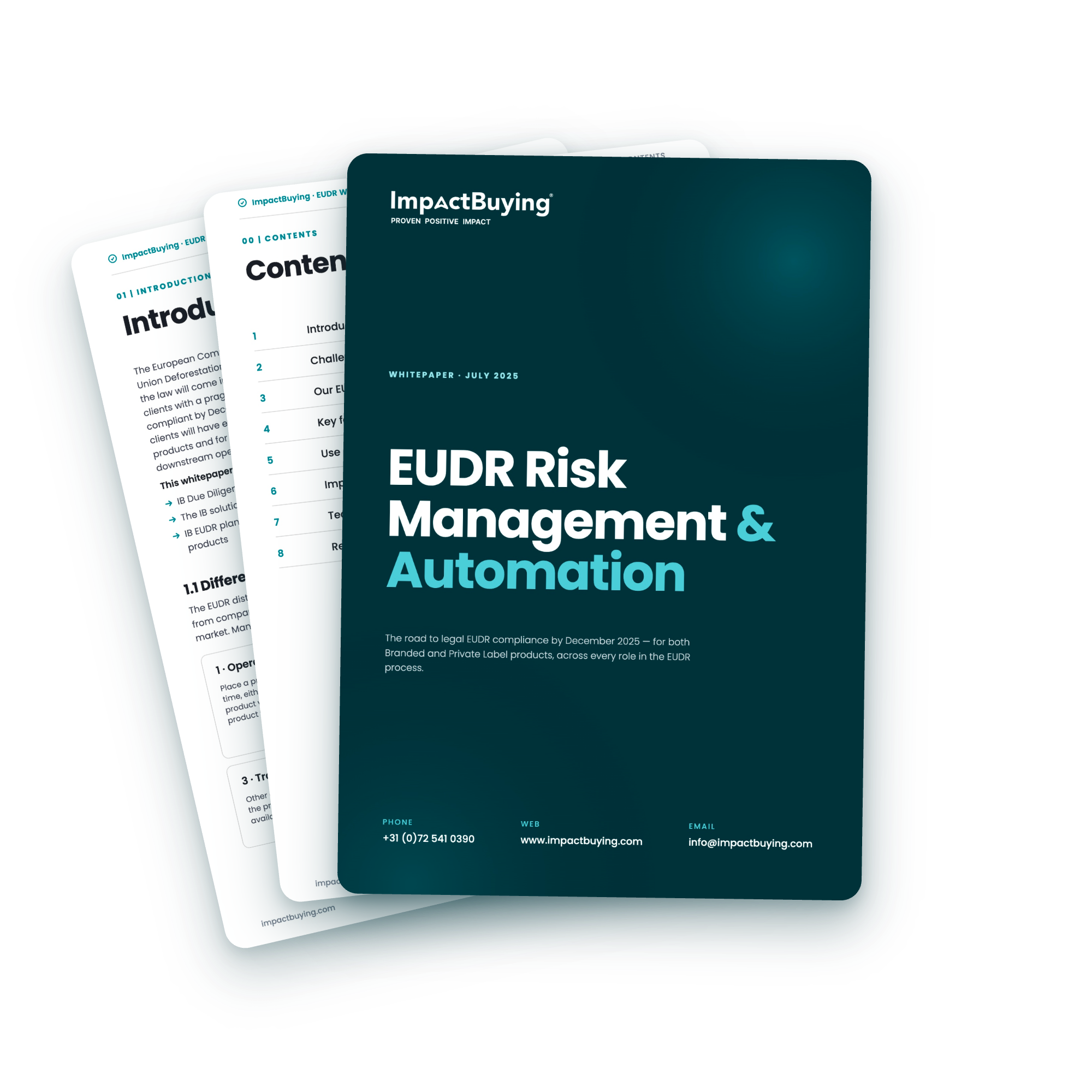
EUDR Whitepaper
European Commission Review Published on 4 May 2026
On 4 May 2026, the European Commission published its long-awaited review of the EUDR, accompanied by updated guidance, revised FAQs, and a draft Delegated Act proposing limited amendments to the list of products covered by the regulation. The Commission’s message was clear: the EUDR is not reopened, and there are no further delays nor postponements.
The current implementation timeline therefore remains unchanged:
– 30 December 2026 for large and medium-sized companies;
– 30 June 2027 for small and micro enterprises that were not previously covered under the EU Timber Regulation (EUTR).
While the Commission estimates that previous simplification measures and updated guidance could significantly reduce compliance costs, the core obligations of the regulation remain fully intact. The review gives businesses a clear signal: preparation efforts should continue without delay.
Which Commodities Are in Scope?
The EUDR covers seven key commodities associated with deforestation risk:
Cattle, Cocoa, Coffee, Palm oil, Rubber, Soy and Wood.
Range of derived products are also included under Annex I of the regulation. The draft Delegated Act published on 4 May 2026 proposes a few adjustments to this product scope. Notably, the Commission proposes:
Adding to scope:
– Soluble coffee
– Selected palm oil derivatives
Removing from scope:
– Leather products
– Retreaded tyres
Clarifying exemptions for:
– Product samples
– Certain packaging materials
– Used and second-hand products
– Waste products
The Due Diligence Statement Obligation
A central requirement under the EUDR is the submission of a Due Diligence Statement (DDS) before relevant products can be placed on the EU market or exported from the EU. Through the DDS, companies must confirm that they have conducted due diligence and concluded that the risk of non-compliance is negligible. This process requires companies to:
1. Collect information on the supply chain;
2. Assess the risk of deforestation and illegal production practices
3. Ensure product traceability up to the piece of land used for primary production;
4. Submit a Due Diligence Statement through the EU Information System TRACES.
The updated Commission guidance provides additional clarification on these obligations, but the fundamental requirement remains unchanged: companies must be able to demonstrate that their products are both deforestation-free and legally produced.
Geolocation Data: What Suppliers Need to Provide
One of the most challenging aspects of EUDR compliance is the collection of geolocation information.
To verify that production did not take place on land subject to deforestation after 31 December 2020, operators must obtain precise geolocation data for the plots where relevant commodities were produced. This information allows companies and authorities to assess deforestation risks using satellite imagery and other verification tools. ImpactBuying can assist, together with partners, in getting this verified data.
What This Means for Businesses
The Commission’s review provides important clarity: the EUDR is moving forward as planned. While some refinements to product scope are still under discussion, the regulation’s core requirements remain unchanged.
Businesses that have not yet started collecting supplier data, geolocation information, and due diligence evidence should treat the coming months as a critical preparation period. With enforcement beginning on 30 December 2026, companies that proactively engage their suppliers and strengthen traceability systems today will be best positioned to meet the requirements and maintain uninterrupted access to the European market.
Vers la mise en conformité avec le règlement EUDR
The European Commission (EC) has confirmed that implementation of this European Union Deforestation Regulation (EUDR) will be enforced. ImpactBuying (IB) provides a pragmatic, down-to-earth approach that ensures that clients are legally compliant. You will have evidence of EUDR implementation for both their Branded and Private label products and for their different roles in the EUDR trade process (trader, operator, downstream operator).
We offer:
- Enregistrement des déclarations de diligence raisonnable en tant que représentant autorisé
- Guide sur le règlement EUDR sur mesure
- Formation du personnel et/ou des fournisseurs
- Évaluation des risques liés aux produits par l'EUDR
Comment nous relevons votre défi lié à l'EUDR
We step in where you need help. From a tailor-made EUDR Handbook to training of staff and/or suppliers, and from basic data verification in your own IT tools to a full-fledged automated IT solution. Just let us know where we can support you to make sure that you are compliant in time. For more details you can download our EUDR Whitepaper or get in contact.
Avantages de la solution EUDR ImpactBuying
Conformité de bout en bout
Assurer la transparence jusqu'au niveau des agriculteurs et au-delà, et disposer des informations nécessaires.
Processus guidé
Notre système propose un guide clair et détaillé qui vous accompagne pas à pas dans les démarches nécessaires pour satisfaire aux exigences de diligence raisonnable prévues par le règlement EUDR.
Flux de travail automatisés
Nous simplifions les tâches complexes liées à la conformité grâce à des flux de travail automatisés, ce qui permet d'améliorer à la fois l'efficacité et la précision.
Mise en œuvre rapide
Intégrez rapidement data existantes sur les fournisseurs data utilisez des modèles et des configurations prédéfinis pour accélérer le processus de mise en conformité.
Adapté aux entreprises de toutes tailles
Que vous gériez quelques fournisseurs ou plusieurs milliers, notre solution s'adapte aux entreprises de toutes tailles et vous garantit une mise en conformité sans heurts.
Stratégie ESG intégrée
Tirez parti de nos solutions complètes pour vous conformer aux réglementations ESG au sens large, en exploitant les informations fournies par divers modules intégrés.
Pourquoi choisir ImpactBuying?
Nous ne nous contentons pas de respecter la réglementation : nous vous aidons à bâtir un avenir durable. Grâce à des outils constamment mis à jour, aux conseils d'experts et à une intégration transparente, nous veillons à ce que votre parcours vers la conformité avec le règlement EUDR soit à la fois rentable et efficace.
Prêt à simplifier la mise en conformité avec le règlement EUDR ?